Placeholder background image
AI Readiness Assessment

Discover Where AI Can Create the Greatest Impact in Your Business

Many organizations invest in AI tools, automation platforms, and digital transformation initiatives without first understanding their readiness, opportunities, risks, and expected ROI. Our assessment provides a structured framework and a clear roadmap forward.

Why Every Business Should Start with an AI Readiness Assessment

Before You Invest, You Need Clarity

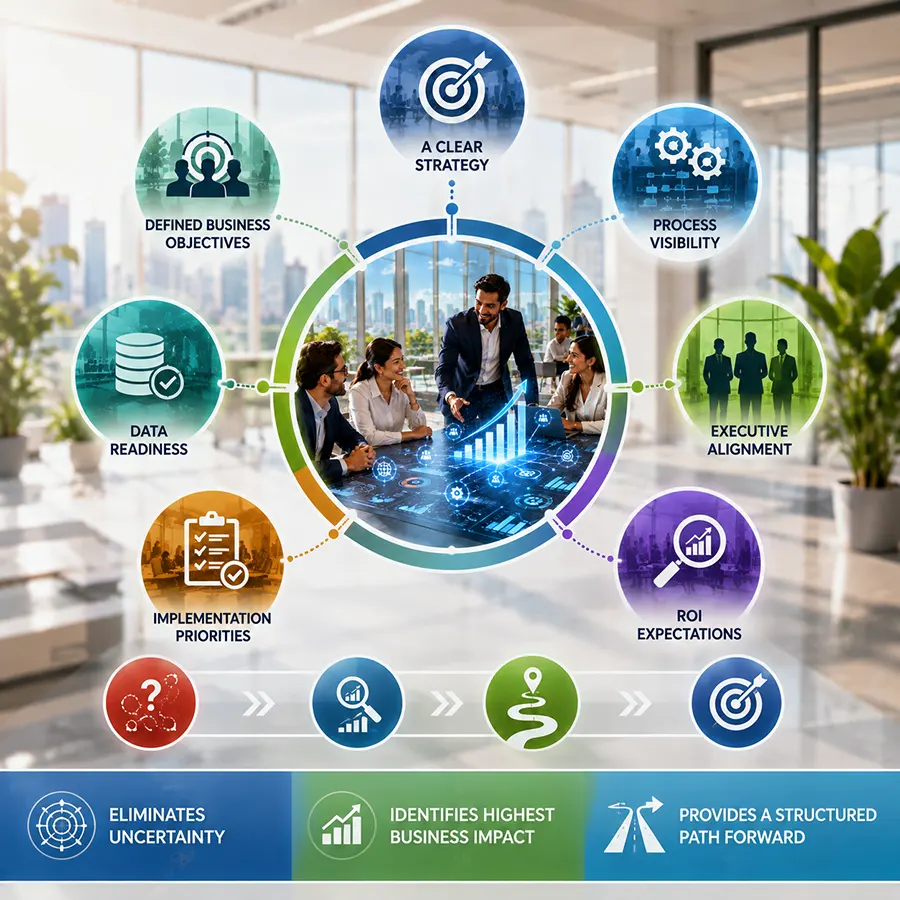
Many AI projects fail not because of technology limitations, but because organizations lack:

  • A clear strategy
  • Defined business objectives
  • Process visibility
  • Data readiness
  • Executive alignment
  • Implementation priorities
  • ROI expectations

Our assessment eliminates uncertainty and provides a structured path forward.

Instead of guessing where AI might help, you gain a detailed understanding of where it can create the greatest business impact.

Placeholder image — why start with an AI readiness assessment
Take the Assessment

Answer a Few Quick Questions

This quick version takes about 2 minutes. For a full evaluation across all 8 dimensions, our team will follow up with your detailed Executive Assessment Report.

Step 1 of 5AI Readiness Assessment

Is there leadership support for AI and automation initiatives?

Not yet — just exploring
Some interest, not prioritized
Actively supported by leadership
Fully committed with budget allocated

How standardized are your core business processes?

Mostly informal / undocumented
Partially documented
Mostly standardized
Fully documented and optimized

How well do your current systems and tools communicate with each other?

Mostly disconnected / manual transfer
Some integrations exist
Well integrated
Fully connected, real-time data flow

How much time does your team spend weekly on repetitive, manual tasks?

Very little — mostly automated already
A few hours per week
A significant portion of the week
The majority of daily work

Almost done — where should we send your results?

We'll email your AI Readiness Score along with a brief summary of opportunity areas.

--out of 100

Thanks! Your preliminary AI Readiness Score is in.

A GENIUS VIBE advisor will follow up with your full Executive Assessment Report, Opportunity Matrix, and Transformation Roadmap within one business day.

Book a Free Consultation
What Is an AI Readiness Assessment?

A Comprehensive Evaluation of Your Organization's AI Potential

The GENIUS VIBE AI Readiness Assessment is a strategic consulting engagement designed to evaluate your organization's current state and identify opportunities for improvement. We assess:

Business Readiness

How prepared leadership and teams are for transformation.

Process Readiness

How well business processes are documented, standardized, and optimized.

Technology Readiness

How effectively current systems support AI and automation initiatives.

Data Readiness

Whether the organization has access to quality data needed for AI-driven decision-making.

Workforce Readiness

Employee capabilities, adoption potential, and change management requirements.

Customer Experience Readiness

Opportunities to improve customer engagement and service delivery.

Automation Potential

Areas where repetitive work can be reduced through intelligent automation.

Governance & Security

Risk management, compliance, and responsible AI adoption practices.

assessment framework
The GENIUS VIBE Assessment Framework™

The G.V.A.R. Model

Our proprietary framework evaluates organizations across four critical pillars.

G
Governance & Leadership
Leadership commitment, strategy alignment, and transformation readiness.
V
Value & Business Opportunities
Productivity opportunities, cost reduction, and revenue growth potential.
A
Automation & Technology
Current systems, infrastructure, and automation capabilities.
R
Resources, People & Adoption
Workforce readiness, change management, and organizational culture.
The 8 Assessment Dimensions

A Full Picture of Organizational Readiness

Evaluates executive commitment and organizational direction.

Key Questions

  • Is there leadership support for AI initiatives?
  • Are business goals clearly defined?
  • Is innovation part of the strategic agenda?

Evaluates operational consistency and process optimization opportunities.

Key Questions

  • Are processes documented?
  • Are workflows standardized?
  • Are performance metrics tracked?

Evaluates current technology capabilities and integration readiness.

Key Questions

  • Are systems connected?
  • Is infrastructure scalable?
  • Are modern digital platforms in place?

Evaluates data quality, accessibility, and reporting maturity.

Key Questions

  • Is business data structured?
  • Can data support decision-making?
  • Are reporting processes efficient?

Evaluates opportunities to reduce repetitive work.

Key Questions

  • Are tasks manually repeated?
  • Are workflows time-consuming?
  • Can automation improve efficiency?

Evaluates customer engagement opportunities.

Key Questions

  • How quickly are customers served?
  • Are communications consistent?
  • Can engagement be improved?

Evaluates employee adoption potential and organizational capability.

Key Questions

  • Are employees digitally capable?
  • Is training available?
  • Is change management supported?

Evaluates security, compliance, and responsible AI practices.

Key Questions

  • Are policies documented?
  • Is access managed effectively?
  • Are compliance requirements understood?
How the Assessment Is Scored

Understanding Your Results

Each dimension is scored 1–5 (Very Low to Advanced), for a maximum assessment score of 40 points.

0–15

AI Beginner

Organizations in the early stages of digital transformation.

Focus: Process documentation, technology modernization, foundational improvements.

16–24

AI Emerging

Organizations with early AI and automation opportunities.

Focus: Pilot projects, workflow automation, quick-win initiatives.

25–32

AI Growth Ready

Organizations positioned for broader AI adoption.

Focus: Department-level transformation, BI, CX optimization.

33–40

AI Transformation Ready

Organizations prepared for enterprise-wide implementation.

Focus: Strategic transformation, advanced automation, AI-driven growth.

What We Analyze

Understanding Where the Opportunities Are

Operational Efficiency

Identify bottlenecks, inefficiencies, and productivity opportunities.

Business Process Automation

Evaluate repetitive tasks suitable for automation.

Customer Experience

Assess opportunities for engagement improvement.

Sales & CRM Effectiveness

Analyze lead management and customer relationship processes.

Marketing Performance

Evaluate customer acquisition and nurturing capabilities.

Reporting & Analytics

Assess business intelligence maturity and decision-making capabilities.

Knowledge Management

Review information accessibility and organizational knowledge sharing.

Placeholder background image
What You Receive

Assessment Deliverables

AI Readiness Scorecard
A visual representation of your readiness across all dimensions.
Executive Assessment Report
A comprehensive report summarizing findings, opportunities, risks, and recommendations.
Opportunity Matrix
Prioritized initiatives based on impact, effort, and expected ROI.
ROI Analysis
Potential productivity, efficiency, and business improvement projections.
Transformation Roadmap
A structured 12-month implementation strategy.
Executive Presentation
Leadership-ready findings and recommendations.
Example Opportunity Matrix

Prioritized by Impact & Effort

OpportunityBusiness ImpactImplementation EffortPriority
CRM AutomationHighLowHigh
Customer Support AutomationHighMediumHigh
Reporting AutomationHighLowHigh
Marketing AutomationMediumMediumMedium
Internal AI AssistantMediumLowMedium
Understanding ROI: The Question Every Business Leader Asks

"What Will We Gain?"

The purpose of the assessment is to identify opportunities that can improve:

0%
Productivity — Potential target: 20–60% improvement
0%
Administrative Efficiency — Potential target: 15–40% reduction in manual effort
0%
Reporting Efficiency — Potential target: 50–80% reduction in reporting workload
0%
Customer Response Times — Potential target: 50–95% faster responses
0%
Lead Management Efficiency — Potential target: 20–50% improvement
Operational Visibility — Significant improvement through dashboards and analytics
Who Should Take the Assessment?

Built for Growth-Focused Leaders

This assessment is ideal for:

  • Business Owners
  • CEOs
  • Managing Directors
  • Operations Leaders
  • Technology Decision-Makers
  • Growth-Focused SMB Organizations
  • Companies Exploring AI Adoption
  • Organizations Planning Digital Transformation Initiatives

Industries We Commonly Assess

HealthcareLogistics & TransportationManufacturing Retail & E-CommerceReal EstateProfessional Services EducationHospitality
Placeholder image — who should take the assessment
Why Businesses Choose GENIUS VIBE

A Business-Focused Assessment Methodology

Business-Focused Assessment Methodology

We focus on business outcomes rather than technology jargon.

ROI-Driven Recommendations

Every recommendation is linked to measurable business value.

Practical Roadmaps

Clear implementation priorities and timelines.

End-to-End Support

Assessment, planning, implementation, and optimization.

Long-Term Partnership

Supporting sustainable business transformation.

Placeholder background image

Want to Know Your Highest-ROI Opportunities?

Our assessment identifies where your organization can improve productivity, reduce costs, and accelerate growth.

Assessment Process

From Discovery to Roadmap

1

Discovery Workshop

Understand objectives, challenges, and priorities.

2

Information Gathering

Review systems, workflows, and operations.

3

Assessment & Analysis

Evaluate readiness and identify opportunities.

4

Executive Review

Present findings and recommendations.

5

Roadmap Development

Create a structured implementation plan.

Stop Guessing. Start Planning.

Build your AI strategy on real data, business priorities, and measurable outcomes.

The Most Successful AI Projects Start with a Clear Understanding of Business Opportunities

Before investing in technology, understand your organization's readiness, priorities, risks, and potential return on investment.